Trans News Friday: Oregon Picks Up the Tab
Last week we asked whether Oregon would keep paying for trans youth care when federal Medicaid money stops on October 13. Now we know: it will. This week also brought a federal appeals court win for trans Arizonans fixing their birth certificates, an Oklahoma ruling that slammed that same door, and $8.9 million from New York City for the clinics stepping in where big hospitals backed out. Here's what it all means for Portland, and what to do before Tuesday.
Oregon Will Keep Covering Trans Youth Care After October 13

Downtown Portland and Mount Hood. Photo: Spicypepper999 via Wikimedia Commons, CC0
On October 2, the Oregon Health Authority published its plan. Starting October 13, OHA will pay for hormones, puberty blockers, and gender-affirming surgery for Oregon Health Plan members under 18 with state-only money, through OHP Open Card (also called fee-for-service). Your coordinated care organization (CCO) still covers everything else, including office visits, labs, therapy, and care coordination. In OHA's words, the federal rule "will not change OHP benefits."
Here's the one thing families need to check: is your kid's prescriber or surgeon enrolled in OHP Open Card? If yes, you don't need to do anything. If not, you'll need a provider who is, and your CCO can help you find one. OHA says it'll honor prior authorizations your CCO approved before October 13, and through April 30, 2027, it'll automatically approve pharmacy prior authorizations for medications a kid already takes, based on their claims history. The details are in OHA's implementation guidance.
Not every state made this choice. Virginia and Arizona, both led by Democratic governors, quietly announced they'll stop covering this care for minors on Medicaid after October 13, with up to six months of coverage for kids already on medication. California and Maine are covering it with state money, and Washington says it's working on its own plan. Oregon's lawsuit against the federal rule, alongside more than 20 other states, keeps going. Oregon law already protected this care. This week the state put money behind that law.
Read the full update at Oregon Health Authority →
Two Courts, Two Very Different Answers on Trans Birth Certificates
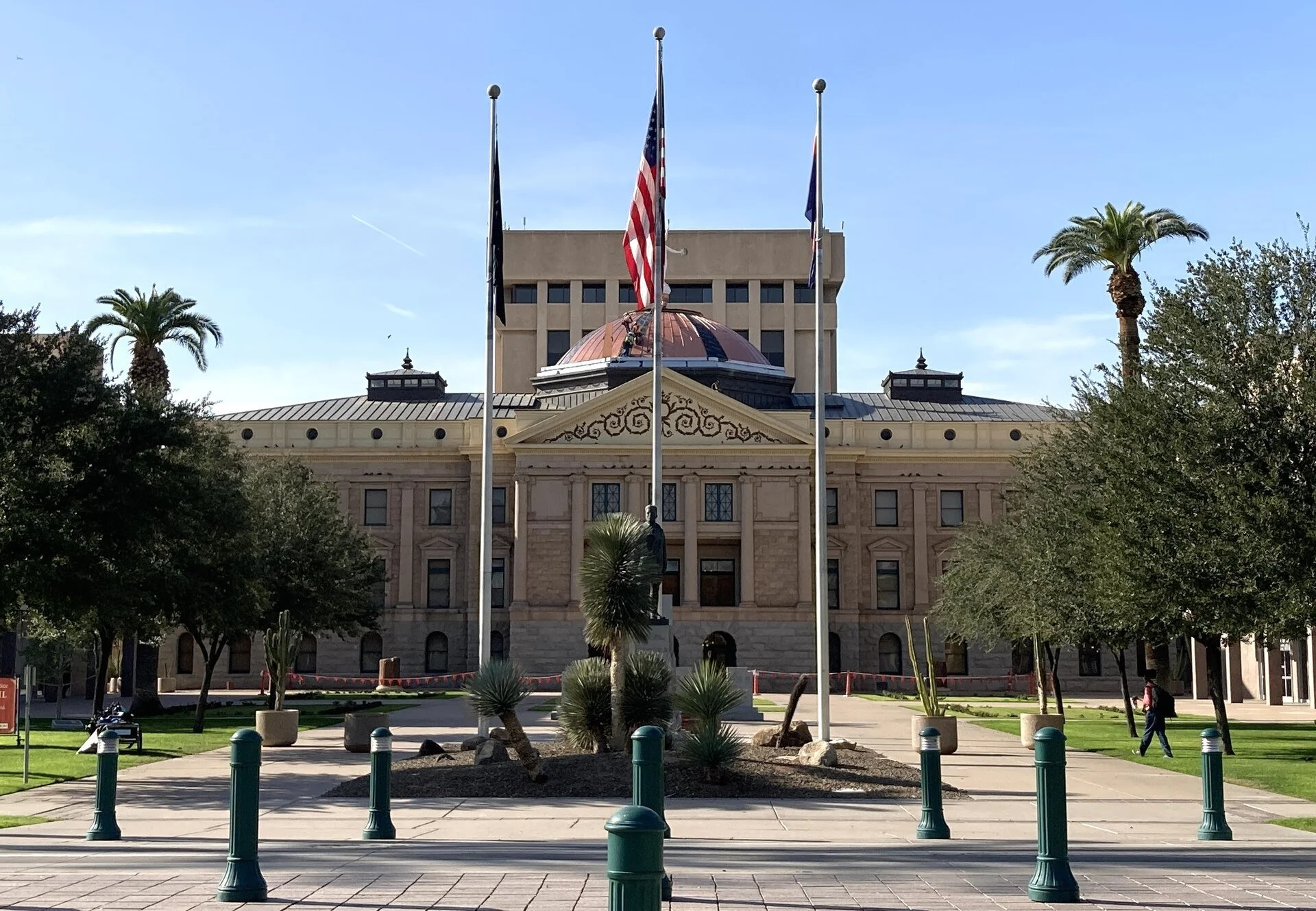
The Arizona State Capitol in Phoenix. Photo: David Jiang via Wikimedia Commons, CC BY-SA 4.0
On October 6, the 9th U.S. Circuit Court of Appeals ruled that trans Arizonans don't need surgery to update the sex on their birth certificates. Judge Roopali Desai wrote that Arizona law offers two paths, proof of surgery or a court order, and that state judges can't refuse those orders because they predict the health department won't honor them. "The statute leaves no discretion to the agency," she wrote. Arizona's Republican legislative leaders had appealed to keep surgery as the only route. The case started with a lawsuit trans Arizonans filed in 2020.
A week earlier, Oklahoma's Supreme Court went the other way. In a 6-3 ruling, it said state law has never allowed anyone to change the sex on an Oklahoma birth certificate, answering questions from a federal appeals court in a lawsuit brought by three trans Oklahomans who'd already won state court orders. The state health department refused those orders under an executive order from Gov. Kevin Stitt. Oklahoma Voice has the details.
Oregon makes this simpler. You can update the sex on an Oregon birth certificate, including to X, with a notarized application to Oregon Vital Records. You don't need a court order or surgery. (That administrative route works once for your name and once for your sex marker; after that, it takes a court order.) If you were born in Oklahoma and live here now, your Oklahoma birth certificate is stuck for now, but your Oregon driver's license isn't. Trans Oregon walks you through every ID change, step by step.
Read the full story at Arizona Capitol Times →
New York City Steps In After Big Hospitals Drop Trans Youth Care

New York City Hall in Manhattan. Photo: Kidfly182 via Wikimedia Commons, CC BY-SA 4.0
New York City's health department said on October 6 that it plans to spend about $8.9 million on community providers that offer gender-affirming care for minors, including puberty blockers and hormones. It's the biggest piece of a $15 million plan Mayor Zohran Mamdani announced in June, and it follows deals NYU Langone and Mount Sinai cut with the Justice Department to stop caring for trans kids. The city named Callen-Lorde Community Health Center and the Nonprofit Organization for Philanthropic Initiatives as likely contractors, and other providers have until October 16 to raise their hands.
There's a catch: the contracts don't start until February 1, 2027, so New York families still face a gap this winter. Community pressure isn't letting up either. Actor Elliot Page joined a protest outside NYU Langone and recorded a message that landed on one line: healthcare is about "caring for people, not caving to politicians." LGBTQ Nation has his full message.
For Portland, the lesson is simple. When big institutions fold, local governments and community clinics can carry the care, and Oregon just showed it's willing to pay for it. If a provider you count on here ever pulls back, call your CCO and reach out to us. You don't have to figure out the next step alone.
Read the full story at Gothamist →
This blog is free. The work behind it isn't.
If WERQ TOGETHER serves your community, power us forward.
More This Week
In Washington, a Puyallup high school wrestler and her mother, represented by Alliance Defending Freedom, asked the U.S. Supreme Court on October 6 to force the state's athletic association to bar trans girls from girls' wrestling before the season starts in November. A federal judge and the 9th Circuit already turned down that request, and the Washington Interscholastic Activities Association says it'll keep following state law, which lets students play on teams that match their gender identity. Washington voters also face two anti-trans measures on their ballots this fall. In Kansas, Judge James McCabria scheduled closing arguments for October 7 in the lawsuit against SB 244, the law that voided trans Kansans' updated driver's licenses, and he's expected to decide in the coming weeks whether to pause it while the case continues.
The 988 Suicide & Crisis Lifeline's "Press 3" option for LGBTQ+ young people came back on September 30. HHS cut it in July 2025, and Sen. Tammy Baldwin and Rep. Raja Krishnamoorthi wrote its return into federal law. HHS hasn't said who's running it now, and The Trevor Project, which built the service, lost its bid to run it again in August. So it's fair to ask how counselors will treat trans and nonbinary youth who call. Trans Lifeline and The Trevor Project's own line, listed below, are still there. Outside the U.S., we didn't find any changes this month that make asylum or relocation easier for trans Americans in Canada, the UK, or the EU. If you're weighing a move abroad, talk with an immigration attorney before you make plans.
What This Means for Portland
If your kid gets hormones or puberty blockers through OHP, make one call this week. Ask their prescriber: "Are you enrolled in OHP Open Card?" If the answer's no, call your CCO for help finding a provider who is, or use OHP's Open Card provider search. Questions about Open Card go to OHP Client Services at 1-800-273-0557. If you hit a wall, the OHA Ombuds Program at 1-877-642-0450 can step in. Providers who still need to enroll can call OHA Provider Services at 1-800-336-6016, option 6.
If anything goes sideways with a prescription or appointment after October 13, write down what happened and when, then tell your CCO and the Ombuds office. And if you're helping someone move here from Oklahoma, Kansas, or anywhere else that's locking down IDs, Trans Oregon's ID guides cover name and gender marker changes in every Oregon county.
What This Means for Our Work
This week's news comes down to two things: who pays for care, and whose ID gets to match who they are. When a state locks birth certificates or drops coverage, some families decide it's time to go. TRFAN, our emergency relocation program, helps people plan that move, starting with a housing plan. Once folks land, Safe Haven Home Share matches them with vetted hosts, and Trans Oregon's guides walk them through Oregon name and gender marker changes. Peer Support Services helps people make the calls and find care, and we can connect you with peer-run groups like Dian's Well, FolkTime, and The Peer Company. And our Arrivals peer group gives people in their first year in Portland a place to find their people.
Take Action
Get this in your inbox every Friday. Subscribe to the WERQ TOGETHER weekly for trans news, Portland resources, and community updates.
Looking for resources? Trans Oregon has step-by-step guides built by and for trans Oregonians.
Power this work. Every dollar keeps peer support, emergency relocation, and community infrastructure running in Portland.
If You Need Support
Trans Lifeline: 1-877-565-8860
Trevor Project: 1-866-488-7386
988 Suicide & Crisis Lifeline: call or text 988
Peer-run support in Portland: Dian's Well, FolkTime, The Peer Company. Peer support from WERQ TOGETHER: get support.
This roundup is news and resources, not legal advice.